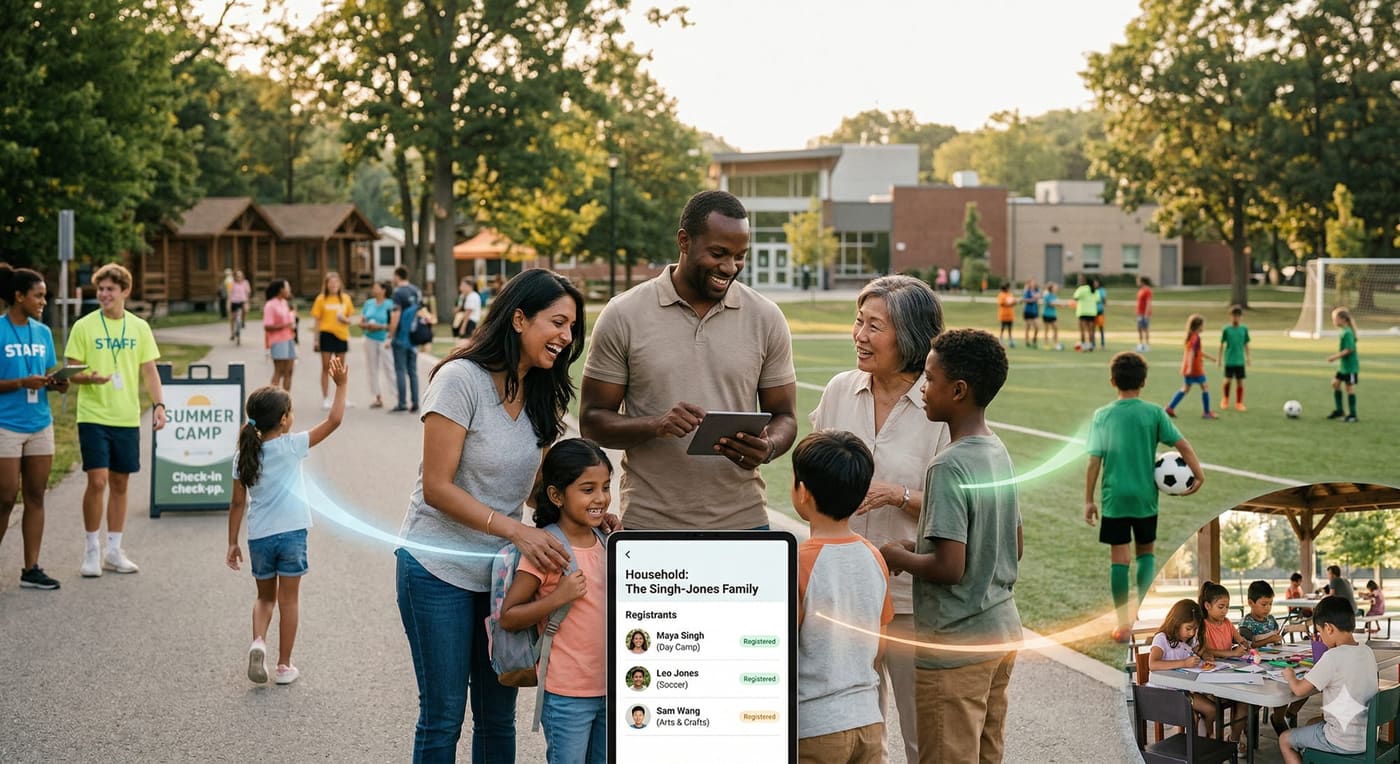
Why CampPulse Uses Household and Registrant, And Why It Makes Everything Work Better

CampPulse Team
In CampPulse, we did not pick our labels casually. Words shape how people understand a system, how they move through it, and how smoothly directors and families get things done.
And let us be honest: the camp and sports-registration world has been drowning in clunky, inconsistent terminology for years.
So we took a clean, intentional approach.
At the foundation of CampPulse sit two key labels:
- Household
- Registrant
They look simple, but they quietly fix a dozen long-standing problems that every camp director knows too well.
Let us walk through the reasoning.
1. “Household” Fits Real-Life Family Structures
Not every family looks like the same picture. Camps see everything: parents, guardians, step-parents, blended homes, grandparents who pay for everything, and combinations you could never predict.
If we had used Family, we would be forcing assumptions.
If we had used Account, we would be turning people into transactions.
Household does the job right.
It is broad enough to handle any real family setup, and personal enough that parents instantly understand it.
And here is the part that matters: anyone added to a household becomes a Household Member.
That includes parents, grandparents, caregivers, staff parents, and of course the kids themselves. It gives directors a clear, unified view of “who belongs to whom”, not just who is registering.
Everything else hangs off the household: people, communication, emergency contacts, carts, orders, and invoices. So when a parent calls, the whole family is on one screen.
2. “Registrant” Keeps Things Precise
Calling someone a camper works right up until the day that person becomes something else. And in youth programs, that happens all the time:
- A camper becomes a CIT.
- A CIT becomes staff.
- A parent becomes staff.
- A staff member registers their own children.
- A teen plays sports all year and attends camp in the summer.
If the system only understands “camper,” everything gets messy.
CampPulse separates the concepts cleanly:
- Person → identity
- Registrant → someone registering for a program
That gives us clarity and future-proofing. A single person can be a staff member and register as an adult participant and register their children, all without creating duplicates or confusion.
3. It Makes the Checkout and Hold System Rock-Solid
The checkout experience in CampPulse anchors everything to the household, not to a single individual.
One household pays for everyone they are registering. That is real life.
So:
- The cart belongs to the household.
- Each cart line belongs to a registrant.
- Capacity checks, mandatory holds, and reservations flow logically from that structure.
That is how we keep the five-minute capacity hold fair, accurate, and consistent. No ghost blocks. No surprise “sold out” messages at payment. No confusion about who is paying for whom.
4. It Scales Beyond Camps
If we want CampPulse to serve organizations beyond traditional camps (and we absolutely do), then the language cannot stay camp-exclusive.
Household + Registrant works universally:
- Athletes
- Dancers
- Swimmers
- Skaters
- Campers
- Students
- Participants
Every one of them fits cleanly under “Registrant.” And because the labels your families and staff see can be renamed in Settings, a dance studio can show “Dancer” and a tutoring center “Student” while the structure underneath stays the same.
5. It Respects Tradition While Building for the Future
Household is a timeless word.
Registrant is a clear, professional term used across modern enrollment systems.
Together, they give us the clarity we need today and the flexibility the product needs tomorrow.
Labels aren't cosmetic. They decide whether a family gets entered twice, whether a bill splits across two guardians, and whether a camper who becomes a counselor keeps their history. Getting them right at the foundation is what lets everything above them stay simple.
← Back to Blog
Ready to See CampPulse 360 in Action?
Registration, billing, capacity, and reporting, connected in one platform built for camps and youth programs.